
DMARC Implementation in Japanese Higher Education: Status and Challenges
In this June 2026 DMARC adoption study, we analyzed close to 1,000 parent domains in Japan’s higher education landscape and the challenges IT teams face in securing their domains.
Though DMARC adoption in Japan’s university domains is growing, it is mostly anchored in the monitoring policy of p=none that provides visibility; however, no enforcement action is taken on emails that fail SPF or DKIM authentication.
DMARC is an anti-spoofing technology that gives visibility and control over how email domains are used.
Unique Challenges Facing Higher Education IT Teams
While major mailbox providers like Yahoo Japan, Yahoo, Google, Microsoft, and Apple have mandated basic DMARC compliance for bulk senders to prevent phishing, higher education institutions in Japan face unique challenges in moving from this monitoring policy to strict enforcement.
Colleges and universities are valuable targets because of the amount of personally identifiable information (PII), financial data, research records, and intellectual property they maintain. Their fragmented departments; shadow IT; and a multitude of third-party vendors, including cloud-based learning management systems and application portals, create a vast attack surface with email at the core.
DMARC adoption specifically in Japan and Asia in general has been sluggish due to varying levels of cybersecurity readiness, rapid digital transformation, and a corresponding increase in cyber threats.
Japan’s Recent Higher Education Data Breaches
The University of Tokyo, Japan’s top-ranked public research institution, suffered a research server data breach after bad actors gained unauthorized access with stolen third-party credentials. After gaining access to the external server, criminals attempted to reach connected university networks to broaden the scope of the infiltration. The university was able to isolate the server and contain the attack before any data was stolen or malware was installed.
In another case, Nippon Medical School Musashi Kosugi Hospital, a prominent, regional teaching hospital and designated disaster center, was the victim of a ransomware attack that affected internal hospital systems. Approximately 10,000 patient records, including names, addresses, phone numbers, and birth dates were initially leaked; that number grew to around 130,000 as investigations continued.
While phishing exploits continue to be the leading intrusion method for installing ransomware, DMARC empowers domain owners to fight ransomware’s attempted delivery. In their #StopRansomware guide, CISA recommends that domain owners authenticate inbound email by using SPF, DKIM, and DMARC to prevent email spoofing.
DMARC Adoption in Japan’s Higher Education Ecosystem
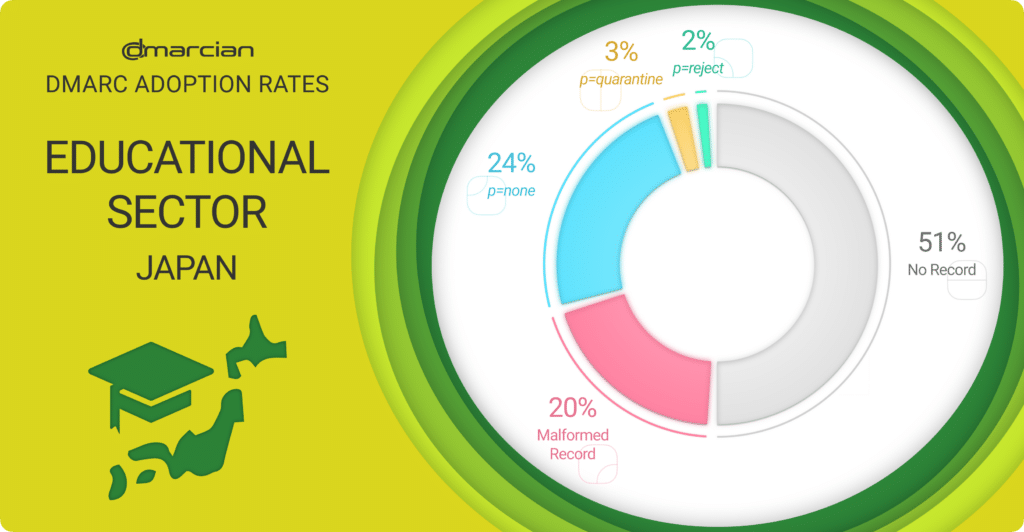
In analyzing the public DNS records of Japan’s higher education sector, we discovered that 95% of the parent domains are not secured from being used in email exploits because they have no DMARC record; have mistakes in their records; or have a DMARC record with a p=none policy, the monitoring phase that doesn’t affect email delivery.
Only 2% are fully protected by the DMARC enforcement policy of p=reject, while 3% have a p=quarantine policy, where failing emails are sent to spam folders.
Following are the full results:
- 51% have no DMARC record.
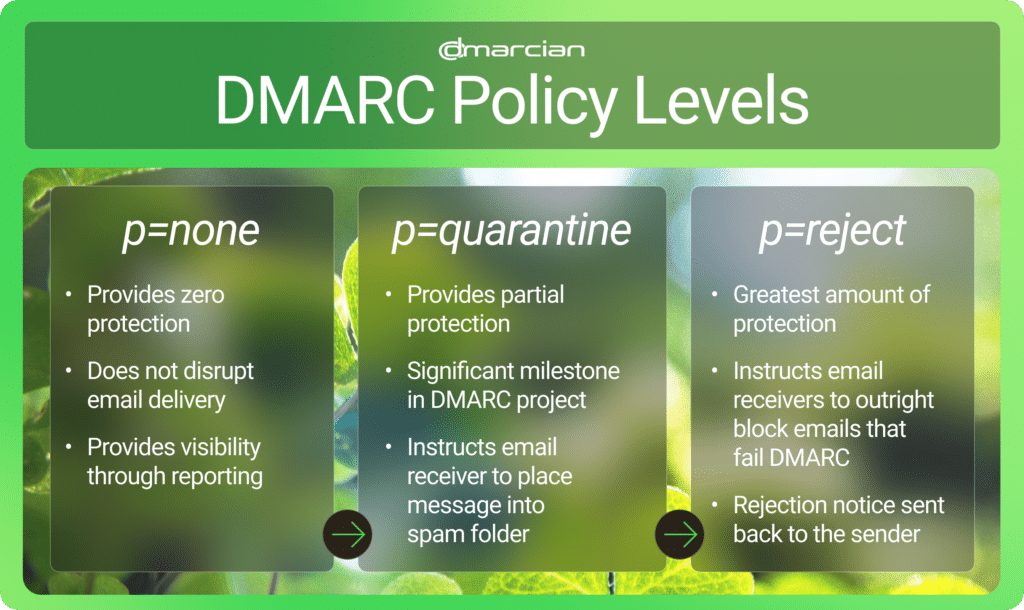
- 24% have a record at the p=none monitoring phase.
- 20% do not follow best practices or have errors, leaving domains exposed or without visibility.
- 3% have a DMARC policy of p=quarantine, the penultimate policy progression before progressing to p=reject.
- 2% are at p=reject, taking full advantage of the protection DMARC offers.
What the DNS Data Reveals
Heavy subdomain usage
While our scope focuses on corporate email domains, the heavy use of subdomains in schools warrants attention. We found that many institutions host their primary website on the root organizational domain but route corporate email through subdomains. Because many of these subdomains lack proper DMARC protection, they present an easy target for phishing attacks that can easily fool everyday users.
DMARC record issues
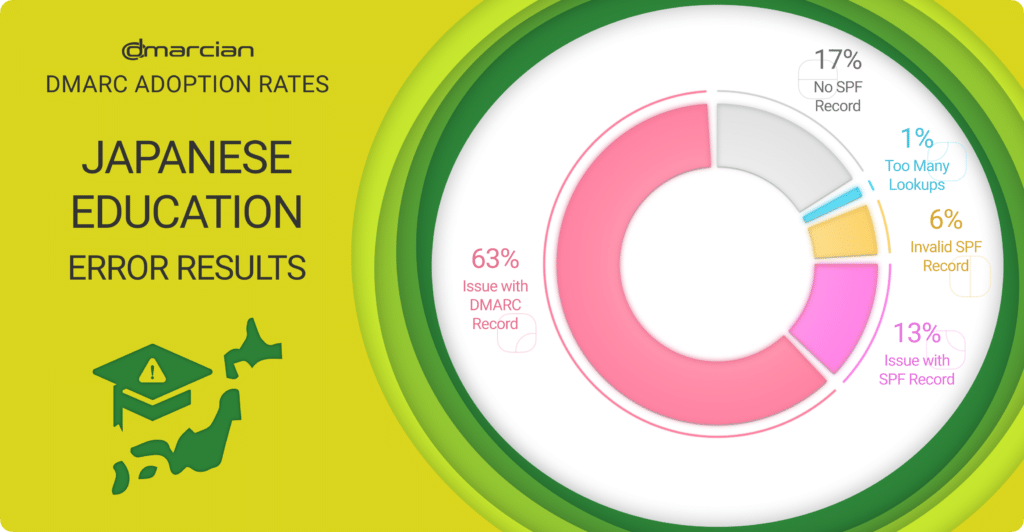
The most common finding, affecting 197 domains, is a DMARC record that exists but contains errors or gaps that render it ineffective or incomplete. The most prevalent issue is the absence of an RUA tag, which is the email address to which aggregate reports are sent.
While a DMARC record with no RUA is still valid, it is vulnerable to abuse. Without an RUA destination, domain owners don’t receive feedback about who (or what) is sending email on their behalf, whether legitimate email is authenticating correctly, or if criminals are actively spoofing their domain. Organizations may set up DMARC and believe they have addressed the problem, and then have no mechanism to know if it is working or being abused. This blind spot puts schools who send sensitive communications to families and students at serious risk.
Fifteen domains have a more specific problem: they are missing the required TXT record in their DNS that authorizes a third-party reporting destination (a mailbox outside of their own domain) for these reports. Organizations often don’t realize this step is needed, and their monitoring setup provides limited information and reporting data can be silently dropped.
Pointing the RUA to dmarcian resolves this problem. As native RUA reports arrive as raw XML files that are difficult to decipher, dmarcian’s DMARC Management Platform converts this data into meaningful visualizations with interactive dashboards that give security teams insights into authentication gaps, details of sending sources and emerging threats.
SPF record issues
Lack of SPF record
Fifty-three of the domains have no SPF record at all. SPF (Sender Policy Framework) is foundational to email authentication, as it tells receiving mail servers which IP addresses are authorized to send email on behalf of a domain. Without it, anyone can send email that appears to come from the school’s domain and the receiving servers don’t realize it is illegitimate.
For schools, a spoofed email appearing to come from a principal or an administrative office is an effective phishing scenario. Parents and students act on school communications instinctively and quickly. The barrier to publishing a correct SPF record is often that schools lack the internal technical expertise or awareness that it is necessary.
Broken SPF records
Of the 62 domains with SPF problems, 18 have invalid SPF records and 6 have published multiple SPF records. Both are damaging in different ways.
An invalid SPF record (one with syntax errors, unsupported mechanisms, or structural problems) is treated by receiving mail servers as if no SPF record exists at all, and the effort of publishing it provides no protection. This is particularly harmful for organizations that believe they have addressed email authentication and are unaware their record is silently failing.
Multiple SPF records are problematic in their own way. The SPF specification explicitly states that a domain must have only one SPF TXT record present. When there are more than one, often the result of different teams or vendors adding their own record over time without coordinating, most mail servers will treat authentication as a failure.
dmarcian provides guided SPF setup that removes the guesswork in identifying legitimate sending sources and constructing accurate records.
During a recent discussion with a Japanese education customer, I encountered a highly insightful perspective that gets straight to the core of DMARC’s true value.
They pointed out that deploying DMARC is not merely a defensive measure to protect one’s own inbound perimeter. Rather, it is an “altruistic approach to security”—one designed to protect the external stakeholders, partners, and recipients who rely on and trust emails bearing your domain name.
Because the immediate, direct benefits of DMARC may not always flow back to the sender, it is true that many educational institutions in Japan have yet to take proactive steps toward adoption.
However, achieving DMARC enforcement is a powerful way to publicly demonstrate an organization’s commitment to security. Keeping our primary communication channel clean and secure is no longer optional; it is a matter of corporate social responsibility and governance. Ultimately, it serves as a critical pillar in cementing the long-term trust and reputation of an institution.
—Masahiro Otsuka, APAC Business Development Manager
We’re here to help Japanese schools
As trusted education sector partners, dmarcian specializes in assisting academic institutions as they navigate the complexities of DMARC implementation. To advocate for the unique needs of schools and their affiliates, we’ve built special pricing and support packages to address budget constraints without compromising on the enterprise-level protection schools need to thrive.
Want to continue the conversation? Head over to the dmarcian Forum.